

Are you concerned about roofing materials warping under the sun or greenhouses becoming unbearable heat traps? Many traditional glazing materials fail to handle high thermal loads, leading to structural deformation and poor energy efficiency. Understanding the science behind polycarbonate's heat resistance is essential for selecting durable, high-performance building materials.

Polycarbonate sheets resist heat through a combination of a high glass transition temperature (145°C-150°C), specialized UV co-extrusion that reflects infrared radiation, and multiwall structures that provide low U-values. While competitive materials soften at 70°C, polycarbonate maintains its structural integrity up to 120°C. By utilizing 100% virgin raw materials and an 80μm UV layer, these sheets can effectively reduce indoor temperatures by 10-15°C while preventing thermal degradation.
To understand why this material is a preferred choice for procurement and global construction, we must examine the specific thermal data and engineering techniques that contribute to its resilience.
What is the maximum temperature polycarbonate can handle?
Polycarbonate is a high-performance thermoplastic known for its exceptional thermal stability compared to materials like PVC or acrylic.
Continuous Use Temperature: Polycarbonate can withstand continuous exposure to temperatures ranging from -40°C to +120°C (-40°F to 248°F) without significant loss of physical properties.
Heat Deflection Temperature (HDT): Under a load of 1.82 MPa, the material resists deformation up to 135°C - 140°C.
Glass Transition Temperature (Tg): The material only begins to transition from a rigid state to a rubbery state at approximately 145°C to 150°C.
Melting Point: As an amorphous polymer, it does not have a sharp melting point but becomes fluid for processing between 220°C and 250°C.
For industrial roofing in regions like the UAE or Central Asia, these high thresholds ensure that the sheets do not sag or buckle during peak summer hours.
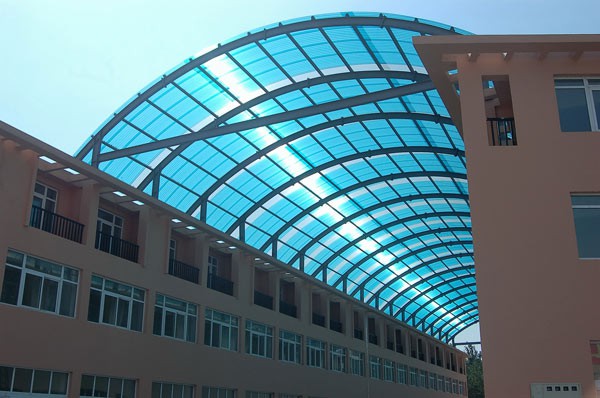
Does the structure of the sheet affect heat insulation?
The physical structure of the sheet is the primary factor in determining its "U-Value"-the measure of heat transfer. A lower U-value indicates better insulation.
Multiwall polycarbonate (twin-wall, triple-wall, or honeycomb) is designed specifically for thermal efficiency. The internal ribs create "dead air" pockets. Since air is a poor conductor of heat, these layers act as a natural barrier.
| Sheet Type & Thickness | Structure | U-Value (W/m²·K) | Insulation Efficiency |
| 6mm Multiwall | Twin-wall | ~3.5 - 3.7 | Standard (Greenhouses) |
| 10mm Multiwall | Honeycomb | ~2.3 - 2.5 | High (Commercial Roofs) |
| 16mm Multiwall | X-Structure | ~1.8 - 2.0 | Superior (Industrial) |
| 5mm Solid Sheet | Flat | ~5.1 - 5.3 | High Impact/Low Insulation |
How does UV co-extrusion prevent thermal damage?
Heat resistance is not just about temperature; it is about managing solar radiation. The sun emits ultraviolet (UV) and infrared (IR) rays which carry significant thermal energy.
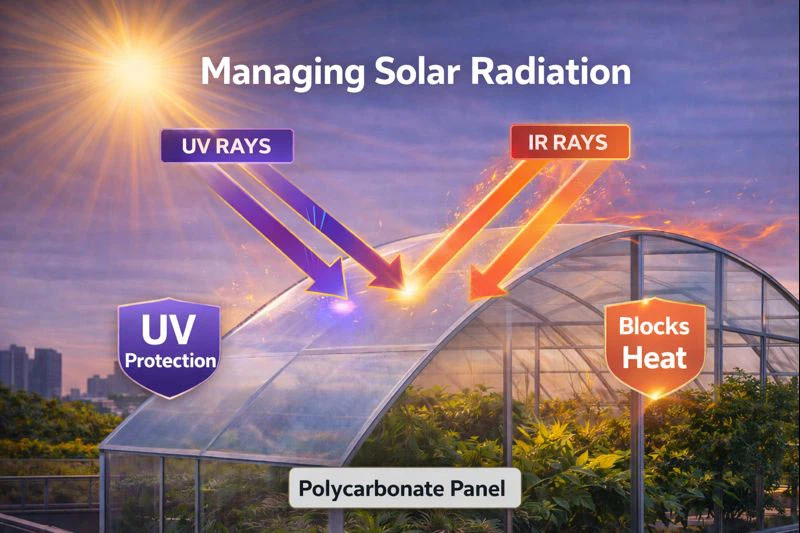
Reflecting Infrared: Advanced UV co-extrusion, specifically when applied at a thickness of 80μm, acts as a shield. It reflects a large portion of the infrared spectrum, which is responsible for the "greenhouse effect" inside buildings.
Preventing Degradation: UV rays break down polymer chains (photo-oxidation). Without a protective layer, the sheet would yellow and become brittle, losing its ability to withstand heat.
Co-extrusion Process: Unlike spray-on coatings, co-extruded UV layers are fused into the sheet during production, ensuring the protection does not peel or wear off over time.
Does color choice impact heat absorption?
The color and tint of the sheet significantly influence the Solar Heat Gain Coefficient (SHGC). This value measures how much solar radiation enters a building.
Clear Sheets: Offer 88%-90% light transmission but also allow the most heat gain. Best for cold climates.
Opal/White: These diffuse light and have a high reflectance, significantly lowering the SHGC.
Bronze/Grey: These tints are highly effective at absorbing and reflecting solar energy, often reducing the temperature of the space beneath by several degrees.
Heat-Stop Additives: Some premium sheets include metallic additives that block heat while maintaining high transparency.
Is polycarbonate better than glass for heat resistance?
In terms of thermal performance, polycarbonate is superior to glass of equivalent thickness.
Polycarbonate's thermal conductivity is approximately 0.21 W/m·K, whereas glass is roughly 1.05 W/m·K. This means PC is naturally five times more resistant to heat flow than glass. Furthermore, polycarbonate is resistant to thermal shock-it will not crack if one side is significantly hotter than the other, a common failure point for tempered glass in desert environments.
How do manufacturing standards ensure heat resistance?
For B2B buyers, the quality of raw materials is the ultimate decider of heat resistance. Using 100% virgin raw materials ensures that the molecular weight of the polymer is high enough to sustain the 120°C operating threshold. Recycled materials often contain impurities that lower the glass transition temperature, leading to premature failure.
Conclusion
Polycarbonate resists heat through high glass transition temperatures, specialized multiwall air-insulation structures, and 80μm UV co-extrusion. By selecting the correct thickness and color, you can achieve a U-value as low as 1.8, ensuring structural integrity and cooling efficiency for over 10 years.
About UNQ
Hebei Unique Plastic Manufacturer Co., Ltd (UNQ) is a leading factory with 6 high-speed production lines. We specialize in 100% virgin polycarbonate sheets with 80μm (or can be customized) UV protection, serving over 1,600 clients worldwide. With 20 years of expertise, we provide professional OEM/ODM services and technical support to ensure your project stands up to the heat.
Interested in high-performance heat-resistant sheets? Contact us at sales@unqpc.com for free samples and technical specifications today!


